Note: No affiliate links here, because Anthropic doesn't run an affiliate program, so this is just a plain rundown. Every number below is from Anthropic's own pages. Where a figure only exists on third-party sites, I say so.
I use Claude Code most days, so when Anthropic shipped two new models three weeks apart, I went digging through the official docs instead of the hype threads. I'll go through what's actually different, plus the one pricing detail that will surprise you.
The short version
In June 2026, Anthropic's model lineup shifted:
- Claude Fable 5 (released June 9) is the new top tier, the successor to Claude Opus 4.8. Anthropic's model docs call it "Anthropic's most capable widely released model." (That "widely released" matters, because Anthropic also has a more capable sibling, Mythos 5, that it keeps behind restricted access.)
- Claude Sonnet 5 (released June 30) is the new mid tier, a drop-in replacement for Sonnet 4.6, built for speed and cost.
If you just want the decision, it's Sonnet 5 for most work, Fable 5 for the hard, long-running coding and agent jobs. The rest of this explains why, plus the catches.
The lineup and the prices
Below is where the two new models sit, with the older ones for context. Prices are per million tokens (input / output), straight from Anthropic's model overview:
| Model | Tier | Input / Output | Context | Released |
|---|---|---|---|---|
| Claude Fable 5 | Top | $10 / $50 | 1M | Jun 9, 2026 |
| Claude Opus 4.8 | (prev. top) | $5 / $25 | 1M | earlier |
| Claude Sonnet 5 | Mid | $3 / $15 (intro $2 / $10 until Aug 31) | 1M | Jun 30, 2026 |
| Claude Haiku 4.5 | Small | $1 / $5 | — | earlier |
Two things jump out. Fable 5 costs roughly double Opus 4.8, a jump TechCrunch flagged too. And Sonnet 5 keeps Sonnet 4.6's exact per-token price ($3/$15), with an intro discount through August 31.
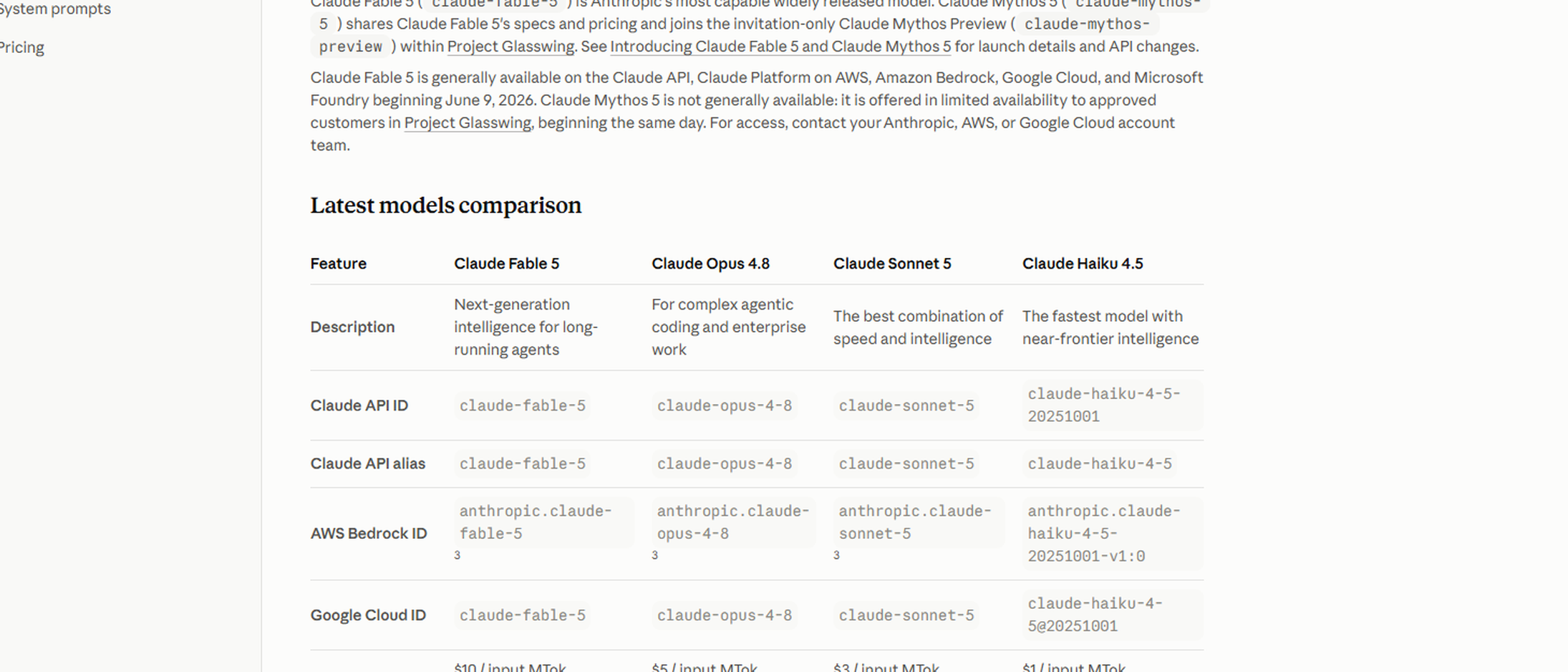 Anthropic's own model overview page, side by side. Screenshot mine. The API IDs and the "widely released" language come from this page.
The pricing trap nobody's flagging
Most roundups miss this part, and it's in Anthropic's own announcement. Sonnet 5 ships with a new tokenizer, and the same text can map to more tokens. Anthropic puts the range at roughly 1.0–1.35x depending on the content type. So it's not a flat number, and at the top of the range it can push a third higher.
Per-token price is unchanged from Sonnet 4.6. But if the same paragraph now counts as up to ~35% more tokens, your real bill for the same work can go up rather than sideways. "Same price" is true per token and misleading per task. Budget for it before you migrate a high-volume workload.
What's genuinely new (and what breaks)
Both models move to adaptive thinking that's always on, so you no longer toggle "extended thinking" manually. On Sonnet 5, the old manual thinking parameter now throws a 400 error, and so do non-default temperature / top_p / top_k values. If you have code that sets those, it will break on the upgrade. Call it a drop-in replacement with an asterisk.
Fable 5's pitch is long-horizon agentic work. Anthropic says it can "work for days at a time," plan across stages, spin up sub-agents, and test its own output. Both models keep the 1M-token context window and up to 128k output tokens (Sonnet 5 can hit 300k output behind a beta header on the Batch API).
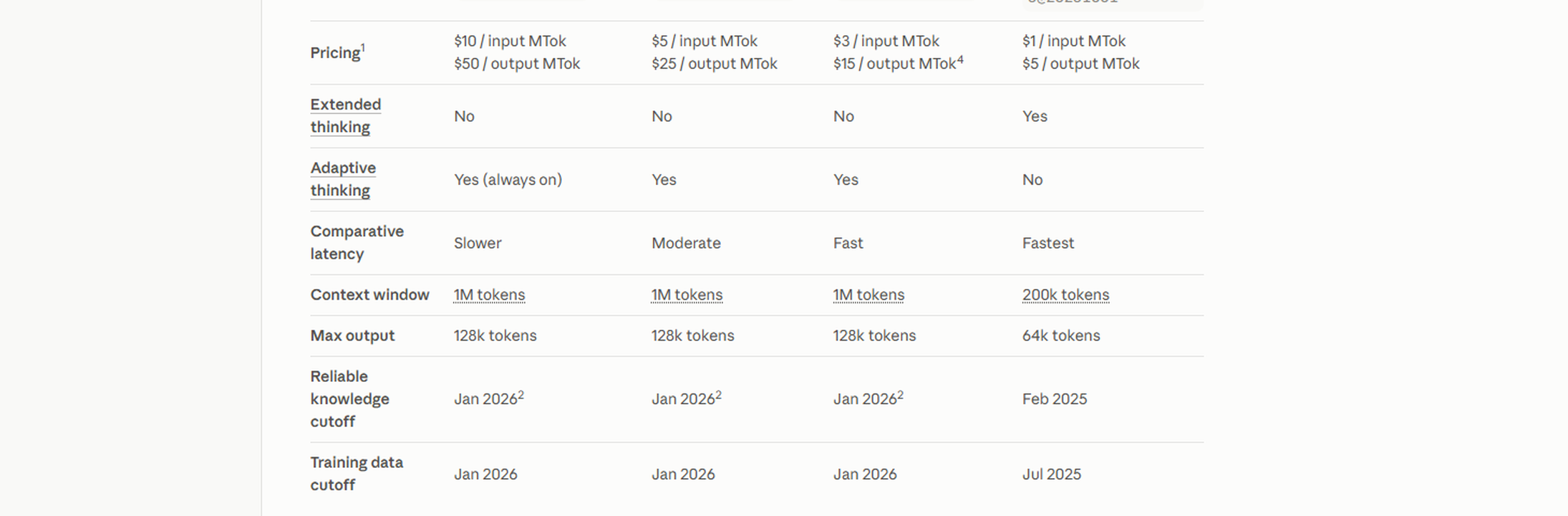 The same official table, lower down. Note "Adaptive thinking: Yes (always on)" and the latency column, where Fable 5 is the slow, careful one and Sonnet 5 sits at "Fast."
One more practical difference: Sonnet 5 supports zero-data-retention; Fable 5 does not. Fable 5 is a "Covered Model" with a mandatory 30-day retention window. If your compliance rules require ZDR, that alone decides it. Sonnet 5 or nothing.
The refusals are real
Both new models carry safety classifiers that can outright refuse a request, and the API returns HTTP 200 with stop_reason: "refusal". On Fable 5, high-risk areas (cybersecurity, biology, chemistry) fall back to Opus 4.8 instead of answering. Anthropic says this fallback path hits under ~5% of Fable 5 sessions, so most work runs untouched. But if you do security-adjacent work, you'll be in that 5%, and you should plan for the fallback.
This isn't hypothetical. On June 12 the US government applied export controls to Fable 5. The move came after officials saw a report in which Amazon researchers bypassed its safeguards to make it identify software vulnerabilities. The controls were lifted June 30, and Fable 5 redeployed globally on July 1 with a hardened classifier Anthropic says blocks that specific technique "in over 99% of cases" (Anthropic's own write-up). A top model that got export-controlled and pulled offline for three weeks in its first month is not a normal launch. Worth knowing if you're betting a workflow on it.
About those benchmark numbers
You'll see confident stats flying around — "80.3% on SWE-Bench Pro," "95% on SWE-bench Verified," "63.2% agentic coding." Here's the honest state of it:
Anthropic's own pages don't publish specific head-to-head scores. They make qualitative claims ("state-of-the-art on nearly all tested benchmarks") and point to a Transparency Hub. The hard numbers you're reading come from third-party aggregators, and they don't line up. One site's 80.3% is SWE-Bench Pro, another's 95% is SWE-bench Verified. Those are different tests wearing near-identical names, which is exactly how these numbers mislead. For Sonnet 5, TechCrunch cited 63.2% on agentic coding (against Opus 4.8's 69.2% and Sonnet 4.6's 58.1%), and one outlet openly noted it hadn't verified the figure.
Translation: treat the exact percentages as rough, not final, until you see them on Anthropic's Transparency Hub or run your own eval. The general shape — Fable 5 strongest, Sonnet 5 close to Opus 4.8 for less money — is well supported. The decimal points are not.
So which one should you use?
- Default to Sonnet 5. It's fast, it's the cheapest of the capable tier, it's near Opus 4.8 on knowledge work, and it supports ZDR. For most coding, writing, and agent tasks, it's the right call.
- Reach for Fable 5 when the job is genuinely hard: multi-hour agent runs, big refactors, the kind of coding problem where a smarter model saves more than it costs. At $50/M output, you want it earning its keep.
- Stay on Opus 4.8 if you need a middle ground on price ($5/$25) or you keep getting bounced by Fable 5's refusals. Opus 4.8 is literally the fallback Fable 5 uses.
- Watch the token bill on Sonnet 5. Same per-token price, ~30% more tokens. Re-measure before you scale.
The honest take
This wasn't a "revolutionary" month, and what landed was a rename at the top (Opus 4.8 → Fable 5, at double the price) plus a solid, cheaper mid-tier (Sonnet 5) with a quiet tokenizer change that muddies the "same price" story. The safety classifiers and the export-control episode are the genuinely new wrinkles, and they matter more for what you can't do than for what you can.
If you're picking one today, Sonnet 5 is the safe default and Fable 5 is the specialist. Just don't let a benchmark screenshot make the choice for you, and check the number's source first. The 80.3% and the 95% you'll see quoted come from two different tests.
Facts sourced from Anthropic's official model overview, the Fable 5 / Sonnet 5 announcement and docs pages, and Anthropic's redeployment note; third-party figures (TechCrunch, Eden AI) are labeled as such in the text. Last checked July 9, 2026.